
Deconstructing the gazes
Who gets to control the means of media production?
In our previous tool on "Optimising for the hegemonic gaze", we highlighted that the media produced by DanceSport - what is shown on the competition dance floor - is constrained by the demands of the straight cis white male thin allosexual gaze. Straight cis white men are mostly in control of key positions of power within the industry. The media they produce, then, aims to fulfil their goals and desires. This, in turn, discourages members of oppressed groups from striving for positions where they can create different imagery. It also makes it difficult for them to distribute this imagery as efficiently as the dominant group can.¹
Learn more
It will be of central importance that the industry makes space for members of oppressed groups within its decision-making ranks (we will address this elsewhere). Of course, we will all need to educate ourselves on the ways in which we participate in oppression, bearing in mind that belonging to an oppressed group does not guarantee that one is not perpetuating one’s own oppression.²
Therefore, we need to counter cultural imperialism by creating alternatives that decentre the oppressive norm.
In this tool, we explore what Latin DanceSport could look like if we gave dancers and choreographers from oppressed groups - such as women, trans, non-binary, BIPoC, fat, and aromantic/asexual people - the means of production over how they are represented. In doing so, we challenge cultural imperialism and the politics of desirability, propriety, and erotic discrimination. Our goal is to celebrate the beauty, diversity, and queerness of dancers from oppressed groups.
It is particularly difficult to imagine other horizons when we have become so accustomed to seeing the same cisheteronormative performances.³
Thankfully, other dance scenes have more experience in that regard, so we turned to them to find out how partner dancing, or dancing in general, could look when members of oppressed groups are free to determine their own representation.
We reached out to dancers of different dance styles, including tango argentino, salsa, vogue (with one shooting from Val and their dance partner, Alex, on DanceSport) and provided them with a photographer for a photoshoot.
Learn more
Due to the limitations imposed by the funder, we were unable to pay for a venue or the dancers' labour. However, we hoped to compensate them to some extent by providing them with the photos for their private and professional use. In this sense, their collaboration falls within the scope of activism. This limited the dancers' ability to create a representation that matched their vision as closely as possible.
When planning the photoshoot, the dancers were encouraged to decide on every aspect of how they wanted to be represented
Learn more
Some found this much harder than others. Social partner dancers are not used to considering how they look to others because their primary audience is their partner, not an external observer.⁴ For us DanceSport folks it was a bit easier. At the same time, however, voguers don’t really understand the point of this exercise because vogueing is all about self-determined representation.
We encouraged them to work with a photographer who is themselves a member of an oppressed group, to ensure that the photographer would also know how to capture the dancers’ agency in the pictures. We display the shots they’ve chosen, alongside their responses to a short interview about how their dance experience interacts with their experiences of oppression.
What might dance look like if members of oppressed groups were free to determine their own representation?
What might dance look like if members of oppressed groups were free to determine their own representation?
Lu & Yolanda - queer salsa


Lu (she/her) is a passionate salsa and tango dancer and a feminist researcher. When she arrived in Vienna in 2023, she started to teach in the project Queer Salsa Wien and at the inclusive dance studio Lilli’s Ballroom to promote dance practices that break with binary and unequal gender relations. Yolanda Schrag (she/her), born in 1996 in Southern Germany. She's a cis-lesbian feminist who is into climate justice activism and Latin music and dances.
“I wish for more spaces that practice role rotation and build a queer and feminist environment with respect and consent.”
Arno & Damian - queer tango


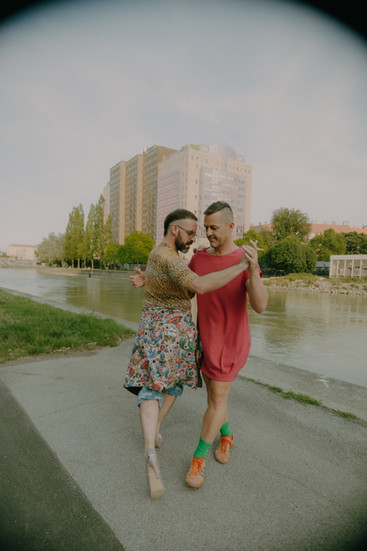


Arno Plass (mixed pronouns) is a movement scholar immersed in queer tango dancing. At the final stage of a PhD, Arno teaches queer tango internationally in both regular dance classes and workshops and as tool for working with theory at universities, co-organizes events (local milongas and a festival in Spain). Damián Cortés Alberti (he/she) is a choreographer, dancer, notator, and researcher from Jujuy, Argentina, currently based in Linz, Austria. His/her work moves between performance, curation, and research, with a focus on dance notation, multimodality, gender studies, and contemporary performance practices. After years of performing across Argentina, Europe, and Asia, Damián shifted towards freelancing and curation, and is now a board member and curator at Red Sapata. His/her artistic practice often crosses disciplines, engaging technology, archives, and queer perspectives to reimagine how dance is created, remembered, and shared.
“My utopian wish is that one day we don't need queer tango anymore, that people understand that we are a diverse species and that the binary is a restriction for everyone.”
Val & Alex - queer Latin DanceSport


Alex (she/her) is a physiotherapist with a strong passion for dance. I’m fascinated by movement, the body, and creative expression. Val (they/sie/elle) is a trans non-binary multi-disciplinary artist, researcher, activist, and lecturer in gender and queer studies. They danced Latin DanceSport competitively together for three years and, still enjoying dancing together, gradually queered their dance practice, no longer taking part in competitions.
“I wish for dance spaces that are truly inclusive and safe—spaces where gender, gender expression, or assigned roles do not limit how or with whom someone can dance.”
Ina - Vogue Old Way





Ina Holub (she/her) is a queer body positivity activist who lives with her wife in Vienna. On Instagram, she blogs about her reality of facing multiple forms of discrimination as a fat, homosexual woman. Ina is part of Mizrahi House, known as ‘Trina Mizrahi,’ and has been teaching voguing for over a year.
Bo - Vogue Femme





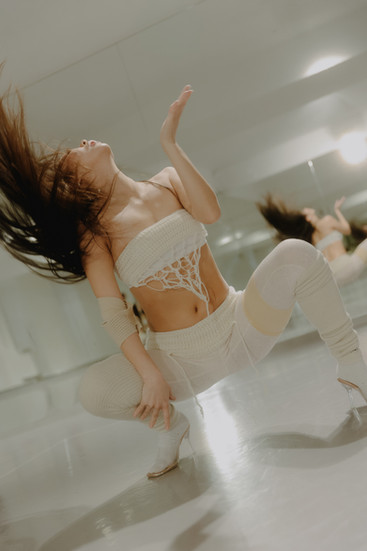


Oyunbat Batsaikhan (she/her) is a dance instructor and coach based in Vienna and Budapest, specializing in heels, hip hop, voguing and experimental movement. Her work celebrates individuality, self-expression and the joy of movement as a tool for growth and connection.
"I dream of a dance world that fully embraces diversity, where queer stories and identities are central."
In Western societies and media, oppressed and othered bodies are both rendered invisible and hypervisible.⁵ They are invisibilised in that they are rarely present or represented; if they are, it is usually in a distorted way. At the same time, their presence is strange and disruptive to the normative functioning of our oppressive societies, making them hypervisible. Fleetwood argues that hypervisibility has deep historical roots in the objectification and negation of Black female bodies, particularly in relation to the gaze and consumption of white bodies and whiteness. Fleetwood explores how Black women might engage with and perform acts of bodily autonomy and resistance through hypervisibility as a resistance strategy.⁶ Building on bell hooks’ concept of the oppositional gaze, creating “spaces of agency … for black people, wherein we can both interrogate the gaze of the Other, but also look back, and at one another, naming what we see”.⁷
What does it mean to look back, disrupt the gaze, fight against it, criticise it, or reappropriate it? We encouraged our participants to look back at the camera to challenge objectification by the dominant culture. In the case of the shoot with Bo, both Val and the photographer, Carina Armes, feature in some of the shots, to prevent the audience from forgetting the context in which these images were produced.
We celebrate the experience of these dancers and their work in other dance styles with this tool. Our aim is to encourage the DanceSport scene to learn from and draw inspiration from these other contexts, and to reflect on the phobias that make it difficult for members of oppressed groups in Latin to achieve this degree of bodily autonomy and co-determination in media production. This tool sends a strong message that centring the voices and projects of members of oppressed groups in dance is both desirable and possible. You just need to care about it.
Centring the voices and projects of members of oppressed groups in dance is both desirable and possible
The crux of representation
And to be clear, we know that the question of representation is ambivalent. In the last 60 years, single-issue politics have advocated for a politics of visibility, with 'coming out' being a significant marker of one's queerness. Mainstream LGBT organisations have called for “casting actors whose identities match their roles and, somewhat less common, for funding LGBT directors and crew to control the means of producing their own images.” However, as Eric Stanley points out, “there is no guarantee that these adjustments will produce anything less dependent or more radically transformative”.⁸ Our approach goes beyond merely offering positive representation as “the remedy for the years of degraded images that are the history” of DanceSport, for doing so would perpetuate the “substitional logic, where representational change is argued to be analogous to structural change”.⁹ Some federations simply open their competition rules to include same-sex couples, then sit back as though they have done a hard day's work, despite making no significant changes to the way they function or the harm they otherwise cause. In other words, queer representation becomes a way to absolve oneself of complicity in oppression – it gives these federations a touch of progressiveness without requiring them to effectively address and abolish the harm and oppression to which they contribute.
Positive representations do not necessarily make our world more liveable; in fact, for some, they have the opposite effect. Being out makes us more vulnerable and easier targets for perpetrators,¹⁰ which raises the question: 'How can we be seen without being known, and how can we be known without being hunted?'¹¹
Opacity and self-determination
Furthermore, we know that such representations are currently forbidden in cisheteronormative DanceSport.¹² So, what can we do about all this? Stanley advocates opacity — a kind of queer and trans maximalism that disturbs the demands of representation, while also addressing the conditions that perpetuate violence and death.¹³ We know that 'images are never enough', and that we must address the harm we are complicit in.¹⁴ At the same time, we can exploit loopholes and deploy 'unruly excesses that build a grammar of trans opacity',¹⁵ like weeds growing between the cracks of DanceSport's hegemonic gaze. In doing so, we must ask ourselves who our audience is. Are we performing for a straight, cis audience for their recognition? Or are we expressing ourselves despite the totalising aesthetics of an oppressive DanceSport world? What small steps can we take to express ourselves without revealing who we are?
Images are never enough, we must address the harm we are complicit in.
Send Comment
Thank you! We are checking your comment.
Comments
Lu & Yolanda
Arno & Damian
Val & Alex
Ina
Bo